
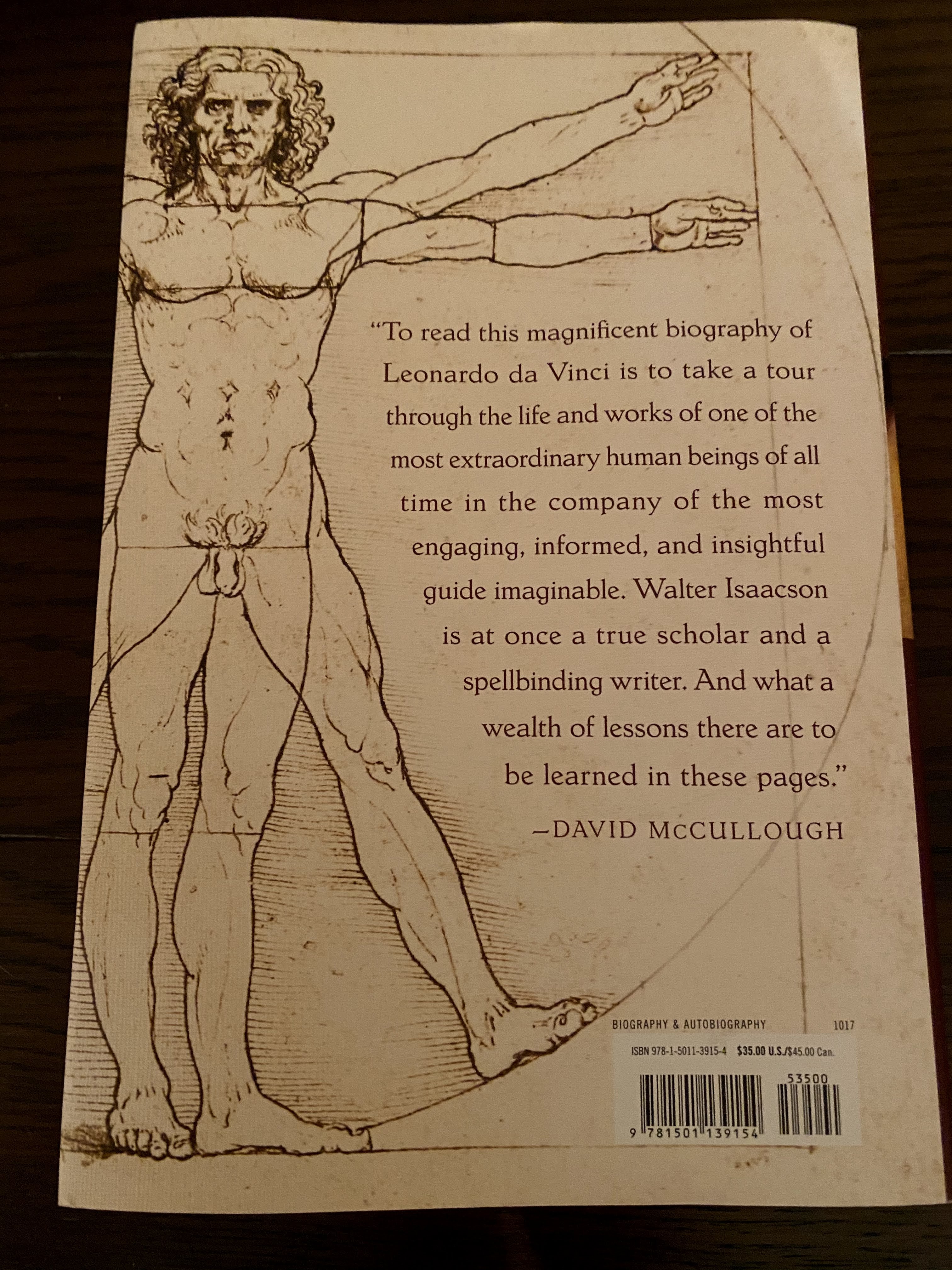
Just finished Walter Isaacson’s LEONARDO DA VINCI. This was a great book, and I highly recommend it. On this blog, I don’t think I have not recommended any books that I’ve recently read; but, I promise you, I always put down books that I don’t enjoy. It’s an anomaly that I’ve recently read so many good books in a row. To reiterate what I wrote in my Currently Reading post, I had really limited exposure/appreciation for art before reading this book. That being said, I found Leonardo just a fascinating subject for a biography, and while he is best known as a painter, his pursuits extended well beyond that discipline.
Baldassare Castiglione, an author and courtier who knew Leonardo in Rome, described him as one “of the world’s finest painters, who despises the art for which he has so rare a talent and has set himself to learn philosophy [meaning the sciences].”
Leonardo Pg. 457
You often here about artists that were not appreciated during their time; that was not the case with Leonardo. His contemporaries knew that he was an extremely gifted painter, and many wealthy individuals begged for portraits, or commissioned him for paintings that were never received. This led some to believe that Leonardo did not relish in his gift for painting, but instead, disliked it. I find this very difficult to believe. With painting, Leonardo sounds like a true perfectionist that painted for himself more than for anyone else. He loved to learn, and as he learned he would update his paintings. If he were to give his paintings away, he could no longer work on them, which I think is one of the reasons not many people got what they commissioned him for. Leonard needed a patron to fuel his insatiable thirst for learning; he did not need a patron to make him rich.
Regarding observation:
He compared it to looking at the page of a book, which is meaningless when taken in as a whole and instead needs to be looked at word by word. Deep observation must be done in steps: “If you wish to have a sound knowledge of the forms of objects, begin with the details of them, and do not go on to the second step until you have the first well fixed in memory.”
Leonardo Pg. 179
The above quote I find fascinating because I wonder how often we take the time to truly observe the world around us. Whether it was the wings of a dragonfly, the illumination of the moon, or the erosion caused by water; Leonardo was constantly observing the world around him with fascination. Many in the art community probably wish Leonardo had focused solely on art, but while the master appears to have had a very intense focus, it drifted between many different subjects. His observations informed his artwork. One of the things I learned from this book was about his use of sfumato in his artwork. Leonard realized that “when we look at three dimensional objects, we don’t see sharp lines” (pg. 55). In order to paint without hard lines, Leonardo pioneered the sfumato technique “…the dissipation and gradual vanishing of smoke into the air” (pg.41). In many of his paintings you will notice this shadowing, or smoky effect and the absence of many hard lines. This does make his paintings appear more ‘real.’
He wanted to accumulate knowledge for its own sake, and for his own personal joy, rather than out of a desire to make a public name for himself as a scholar or to be part of the progress of history. Some have even said that he wrote in mirror script partly to guard his discoveries from prying eyes; I do not think that is true, but it is indisputable that his passion for gathering knowledge was not matched by one for sharing it widely.”
Leonardo Pg. 423
I’m in agreement with the author that Leonardo was not trying to shield his knowledge from others. However, it is very frustrating reading this book and discovering that Leonardo was hundreds of years ahead of the world in several areas, but because he never published anything, his knowledge needed to be rediscovered by others. Like his sfumato technique, I think Leonardo viewed knowledge like smoke; it was difficult for his to commit it to sharp lines on a page. He was always learning more and updating his notebooks and paintings based on what he learned. Committing his observations to a book, I think was just too final for him. It’s also clear that he could be distracted by his many fascinations, and the tedious task of compiling all of his notes for publication was probably too much for him. While the world would have benefited from learning what Leonardo had already discovered, he was always pursuing new concepts, and didn’t have the desire to cement his findings.
This was a very interesting book about a very interesting character. As I mentioned, I really enjoyed it. It makes me feel lazy for not having more hobbies. I did mention in my earlier Currently Reading post that one of the main reasons I was attracted to this book was my curiosity about how the Mona Lisa came to reside in France. After reading this book, I can’t say I have it fully figured out. I will not go into what causes my confusion here, but in general this book presented many more mysteries with regard to the life of Leonardo than it resolved. I mean that in a good way. It seems there will always be more to discover about him.
 My Events